An advisory firm run by a developer
A developer on your deal. A system behind him.
The Kramer Companies does the work a development team does, from the first site screen to the exit, for owners, buyers, lenders and firms. Every model, review and report runs on a system built on live projects: house rules, specialist agents that check each other, and a red team before anything reaches you.
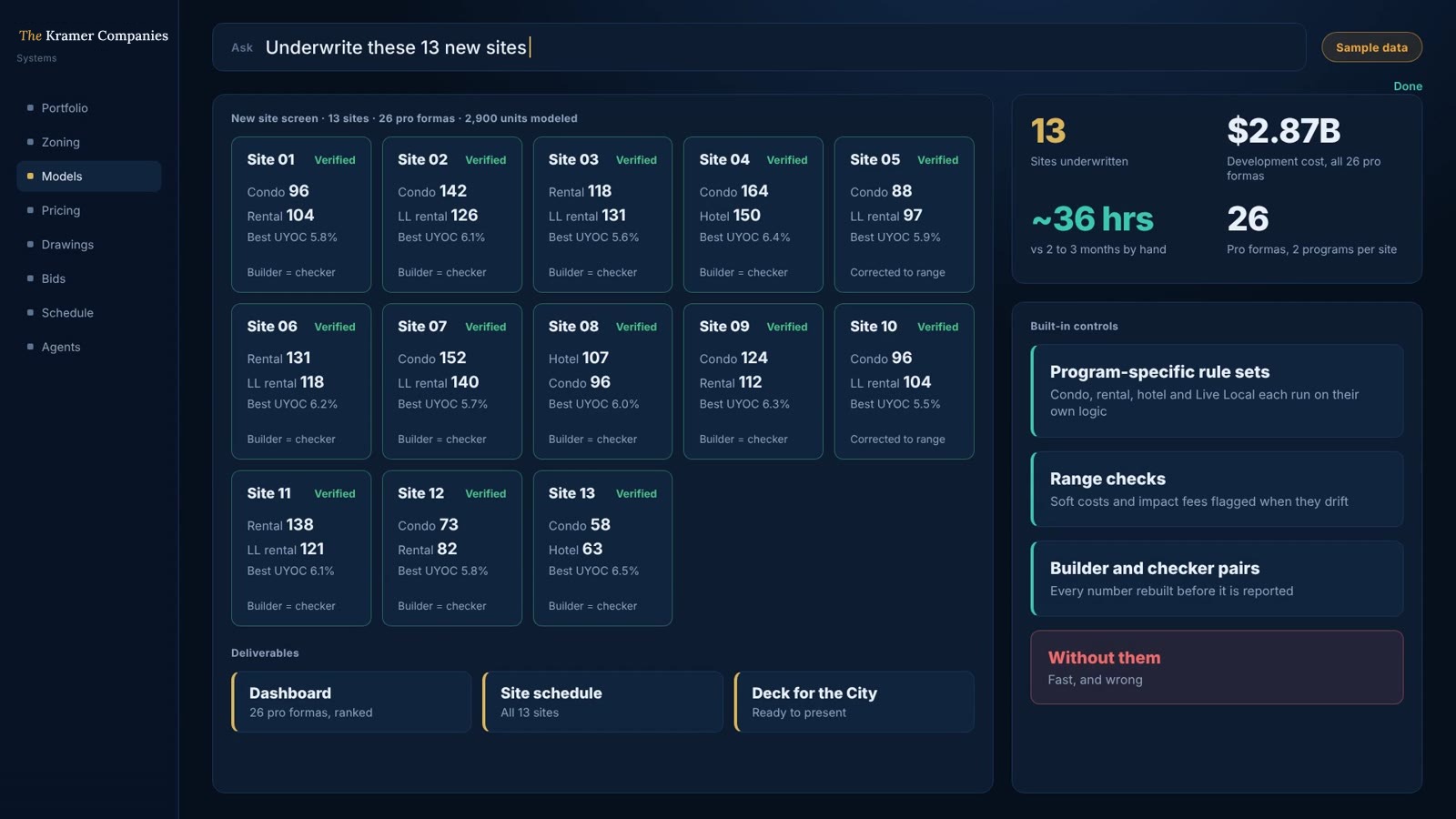
Thirteen sites underwritten in one run, each verified by a builder and checker. Demo screen, sample data.
About 2,900 units modeled, every site under two different programs, ranked with a dashboard, a site schedule and a deck. A job that takes a team two to three months by hand, done while running 5 to 6 live projects. Each model was checked by a second agent before it was reported. Garrett's own track record.
Four verticals
One firm, one way of working, four ways to hire it
Each vertical runs on the same house rules and checks, so the underwriting behind a broker's price, an acquisitions memo and a development budget all agree.
Every stage, screen to exit
A developer on your project at every stage, from the first screen to the sale or refinance.
- 17 stages, from deal screening to sale or refinance
- Design management from concept through CDs and permit
- Buyout, GMP and construction administration
- Any stage on its own, or owner's rep start to finish
Fee structureEach service is flat per task or phase, or a recurring monthly fee. Full development management is a percent of total project cost (land and financing excluded) or a fixed monthly amount.
See development consulting AcquisitionsAny asset, screen to handoff
Buy-side support for any asset type, at every phase, distressed paths included.
- Every asset type, land to notes and REO
- Screening, underwriting and max price
- Due diligence: list, tracker, data room, memo
- Pre-sale, auction, note and REO paths
Fee structureFlat per task or phase, or a recurring monthly fee. Never contingent on a closing.
See acquisitions BrokerageDeal flow and transactions
Deal sourcing and transactions run as a team under [Brokerage Name], with a developer's underwriting behind every price.
- Distressed screening across three counties
- Buyer and seller representation
- Auction and note deals
- Offering packages
Through [Brokerage Name], licensed real estate broker.
Fee structureCompensation only through [Brokerage Name], under a written brokerage agreement.
See brokerage SystemsThe operating system
The development operating system built inside Claude, installed for your firm and run on a recurring monthly fee.
- House rules, skills and templates
- Engine on our secured server, under license
- Launch on a live project and train the team
- Weekly health sweep and monthly tuning
Fee structureAn install fee plus a recurring monthly fee. The engine runs on our secured server under a license.
See systemsHow we engage
A task, a phase, a point in time, or start to finish
Every vertical can be hired four ways. Take one deliverable, hand over a whole phase, get a second opinion before a decision, or keep one lead on it from the first screen to the last report.
Single task
One defined deliverable with a fixed scope, for example one underwriting model or one drawing set review.
Single phase
Every service in one phase of the vertical, run as one engagement, for example due diligence or entitlement and design.
Point in time
An independent check at a decision point: before IC, before a draw is funded, before a bid is awarded, before a permit submission or before a bid day. Short, fixed scope.
Start to finish
The whole vertical, from the first phase through the last, under one engagement letter and one lead.
Walkthrough
See the system run a real week of work
About five minutes on how a request becomes a checked deliverable: the agents, the checks, the underwriting, the design study and the drawing review.
Demo screens use sample data.
The economics
About 14 hours back per project, every week
A development manager spends about 23 hours a week on each active project, which is why the standard load is 2 to 3. The system takes the analytical work down by about 80% and the coordination by about 60%. The meetings, site walks and judgment calls stay with people.
| Weekly hours per active project | Before | With the system |
|---|---|---|
| Pro formas, budgets and cash flows | 4 | 0.8 |
| Bid and consultant leveling | 3 | 0.6 |
| Drawing and document review | 3 | 0.6 |
| Schedules | 2 | 0.4 |
| Reporting to ownership and partners | 2 | 0.4 |
| Email, follow-up and coordination | 5 | 2 |
| Meetings, site and judgment | 4 | 4 |
| Total per project | 23 | 8.8 |
At a 50 to 55 hour week: about 2.3 projects per development manager before, about 6 with the system. Hours are estimated from the builder's own projects; a paid proof measures them on yours.
Agents
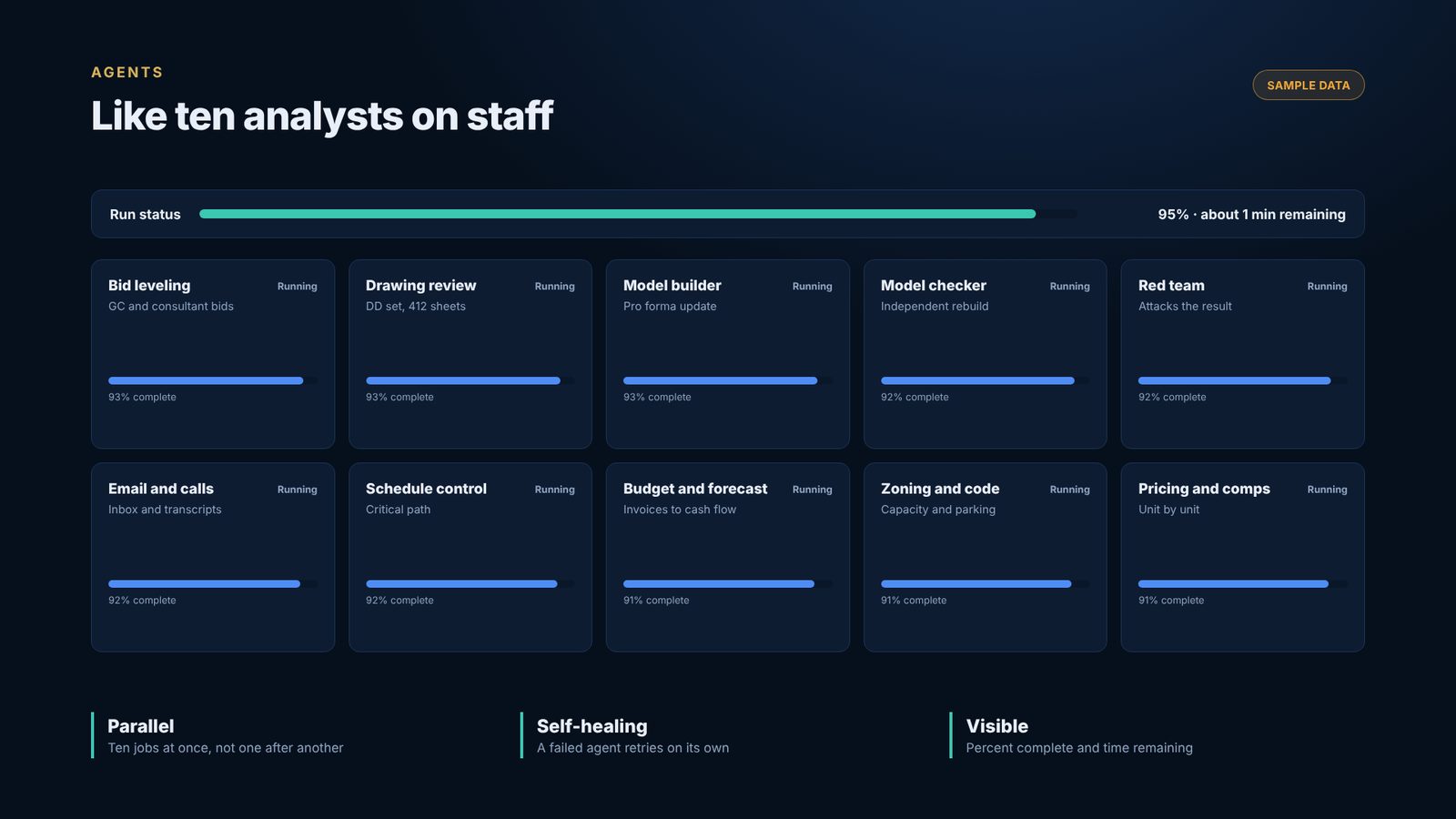
It works like ten analysts on staff
Behind every request, the work is split across specialist agents that run in parallel and check each other.
- Specialists. One levels bids, one reads drawings, one rebuilds the model, another checks it independently.
- Builder and checker pairs. Every number is rebuilt from scratch by a second agent and must match to within $5K and one basis point.
- Red team. A separate agent with one job: attack the work. Every number, every source, every claim that something is missing.
- Self-healing. A failed agent retries on its own, and only the failed piece reruns after a fix.
- Visible. Percent complete and time remaining, on the phone, while the run finishes overnight.
Underwriting at volume
Pro formas with little to no mistakes, at volume
Speed only matters if it is right, so every site runs through the buy box, the rule set for its program, and the same checks. Condo, rental, SFH and townhome, and Live Local each carry their own absorption, pricing, cost, fee and timing logic.
Every line, as % of hard cost, $/GSF and $/unit, against ranges from vetted models. Each outlier gets a cause, a verdict and its effect in basis points.
A result that looks too good is traced line by line first: profit margin above 25%, UYOC above 8%, levered IRR above 30%, or a swing over 300 bps.
Every deal comes back Clear, Short or Negative against your hurdles, with the drivers stated and open questions priced.
Same question, two systems
The model underneath is the same. The results are different because of the rules, checks and skills built on top of it, each one written the day something specific went wrong.
General AI tool
- ✕Land basis assumed, not taken from the contract
- ✕Soft costs and fees outside any normal range
- ✕No checker, no reconciliation, no source for a number
- ✕Looks finished and reads confident
Our system
- ✓Reads the house rules before it opens a single file
- ✓Pulls the program rules and deal-specific items from the register
- ✓Range checks every line and traces outliers to the cell
- ✓Flags what it cannot source and never guesses
Development Consulting · drawing review
Every drawing set reviewed, priced and tracked to the fix
Five reviewers work the set by role, the owner reviewer ranks everything by money, schedule and approval risk, and a red team checks the findings. The results go back on the drawings and are backchecked against the consultants' responses. It runs on Bluebeam Core, with your rules and benchmarks.
A-201
M-101
A-105
A-501
Sample data. Every finding carries its question ID, sheet, the code line tested, required against shown, and whether it was read on the sheet, derived from it, or inferred and awaiting confirmation.
The core of AI drawing review, on Bluebeam Core
Bluebeam Max
$590per user per year, introductory
- AI drawing reviewSmart Review
- AI set comparisonSmart Overlay
- MCP and AI connectionAn AI assistant works in Revu directly
Bluebeam Core with this system
$330per user per year, plus the system
- Role-based reviewFive reviewers and a red team, on your rules and your benchmarks
- Set compareSheets matched by number, changed sheets ranked, red and green overlay
- CSV handoffYou take off and export in Revu, the system reads the file
Prices as listed on Bluebeam's pricing page, October 2026. Bluebeam and Revu are trademarks of Bluebeam, Inc. The Kramer Companies is not affiliated with Bluebeam.
Design study
See the design and the numbers together
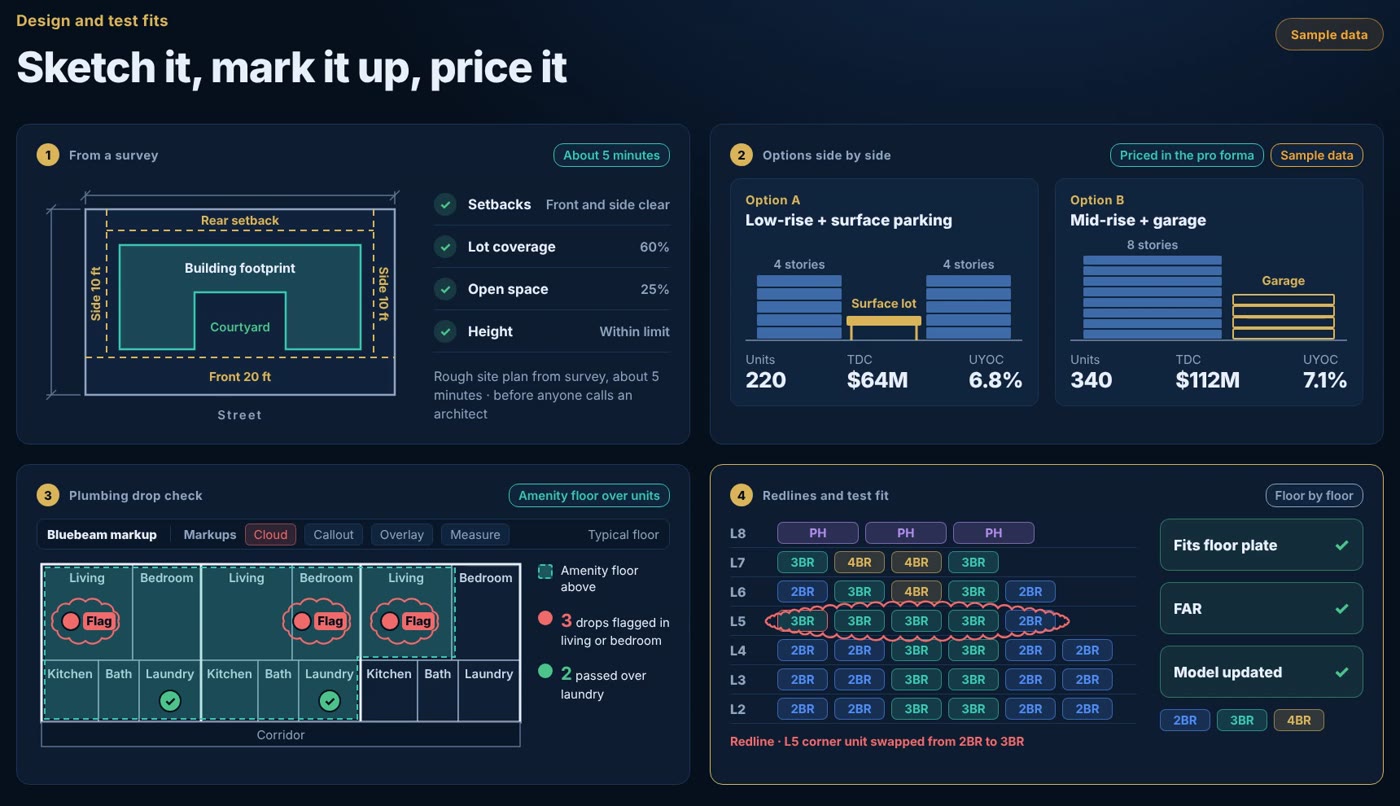
Sketch an option, mark it up and price it in the same pass. Every sketch is priced in the pro forma before the architect redraws.
- Site plans from a survey. Setbacks and code limits right in minutes, before anyone calls an architect.
- Options priced side by side. Low-rise with surface parking against a taller building with a garage, each with units, cost and return.
- Markups and overlays. Amenity floors over units and plumbing drops in living rooms flagged before the architect redraws.
- View study. Pricing by unit against the comps instead of a flat floor premium.
Brokerage · the signal ladder
Five stages of distress. Three counties. One weekly screen.
Lis pendens, judgments, auction calendars, tax lists, CMBS filings. The screener reads them every week, places each parcel on the ladder, matches the play that fits and scores it 0 to 100. Earlier rung, more room to work.
- 1
Watch
Tax delinquency, code liens, CMBS watchlist, a maturity inside 18 months, a stalled permit.
- 2
Filed
Lis pendens or foreclosure complaint, receivership, bankruptcy filing.
- 3
Judgment
Final judgment usually sets the sale 20 to 35 days out, unless it is reset.
- 4
Sale set
Auction date on the county sale calendar.
Most buyers find it here - 5
REO
Lender owned, or the note is for sale.
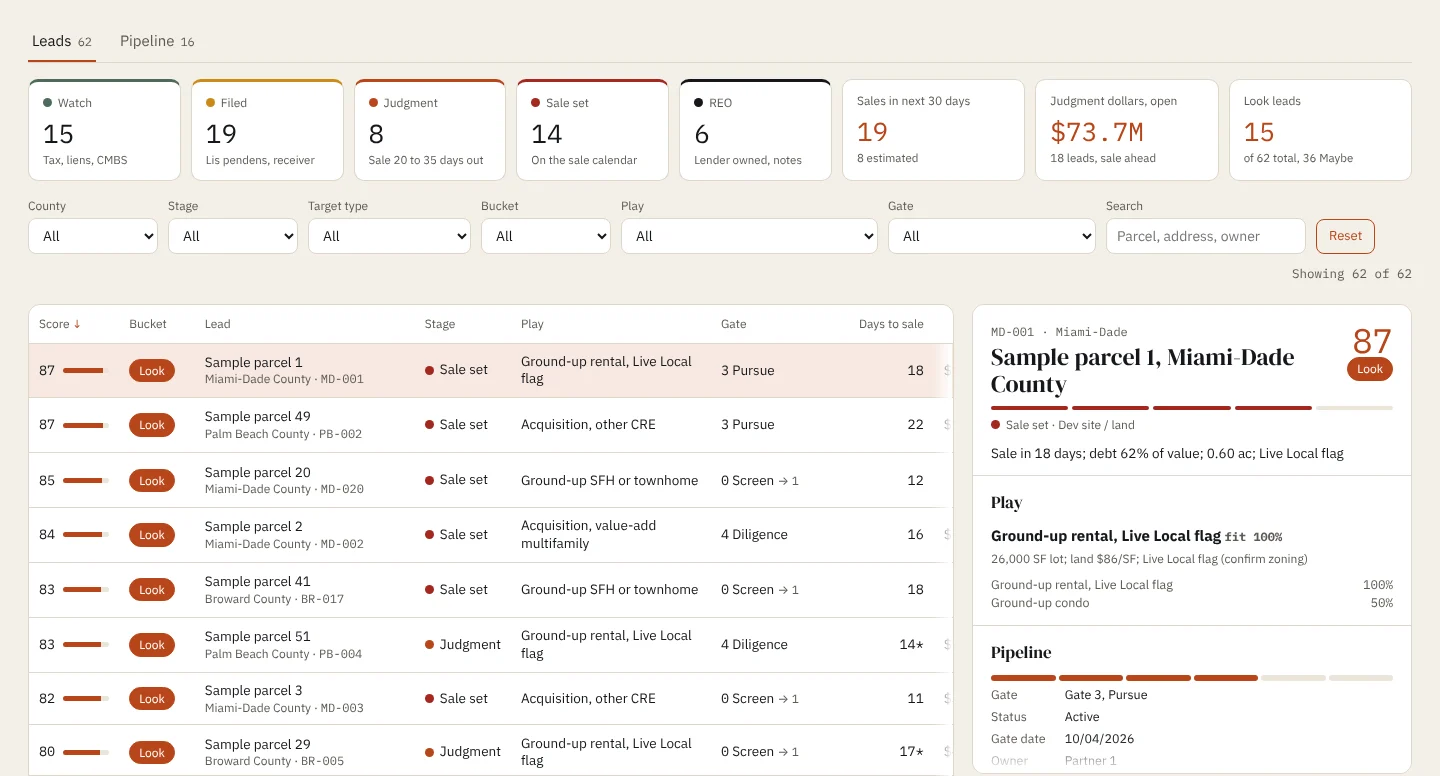
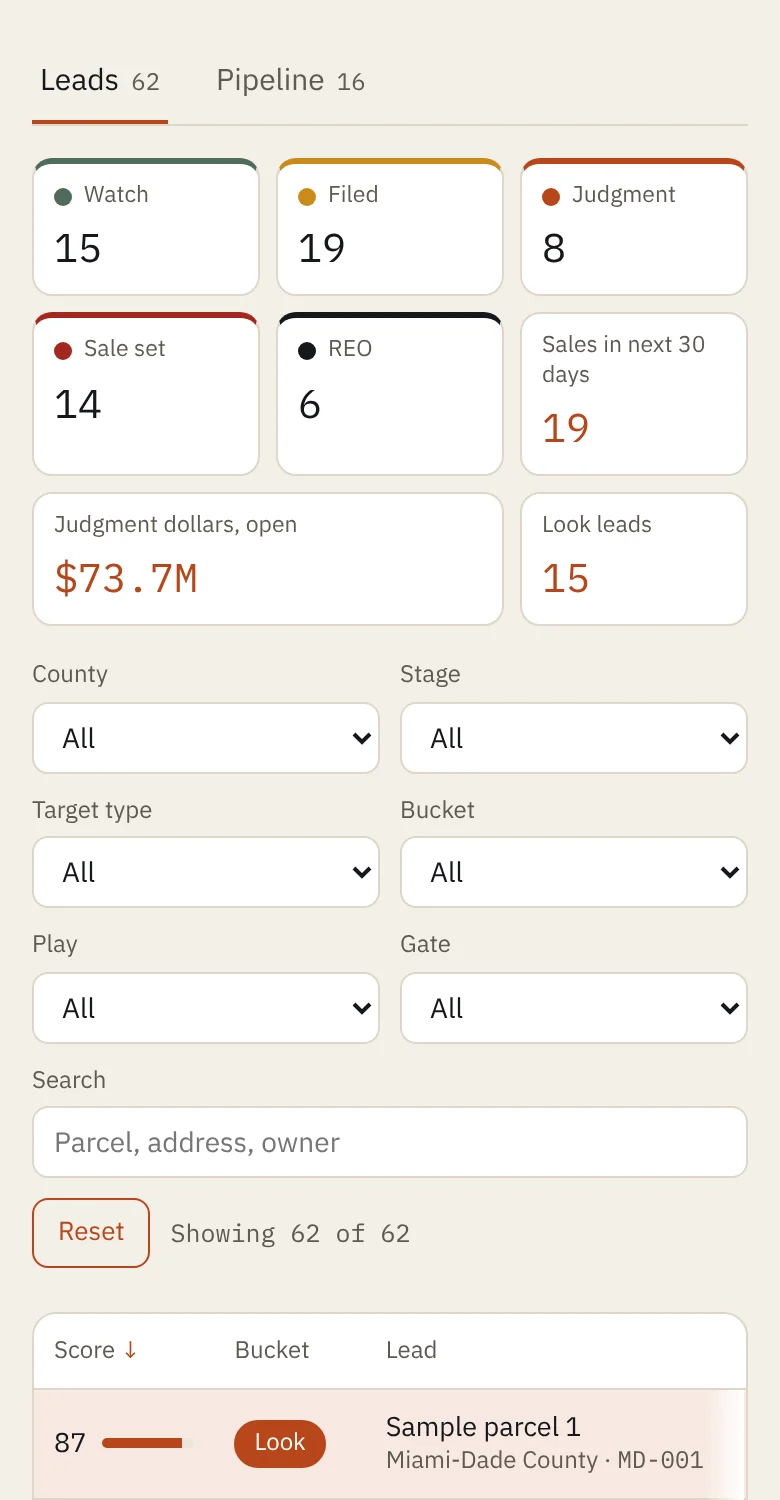
The weekly screener, current run. Sample data, fictional leads. Brokerage services are provided through [Brokerage Name], licensed real estate broker.
Acquisitions · sample deals
Not a lead. A package.
Two deals worked end to end, one ground-up and one acquisition. Fictional sites, real method. Every number traces to a model cell, and where a scheme fails, the package says so.
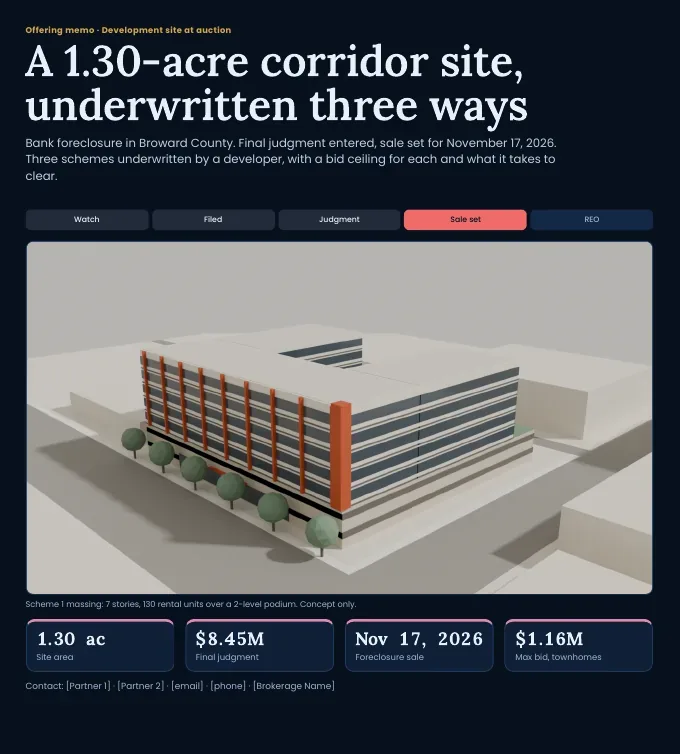 Deal A · Ground-up
A 1.30-acre corridor site at auction
Three schemes on one parcel. At a 150 bps spread the rental pays $0 for the land; townhomes clear at $1,162,000, far under the bank's credit bid. The package says pass.
Sample deal, fictional site. Estimates, not an offer.
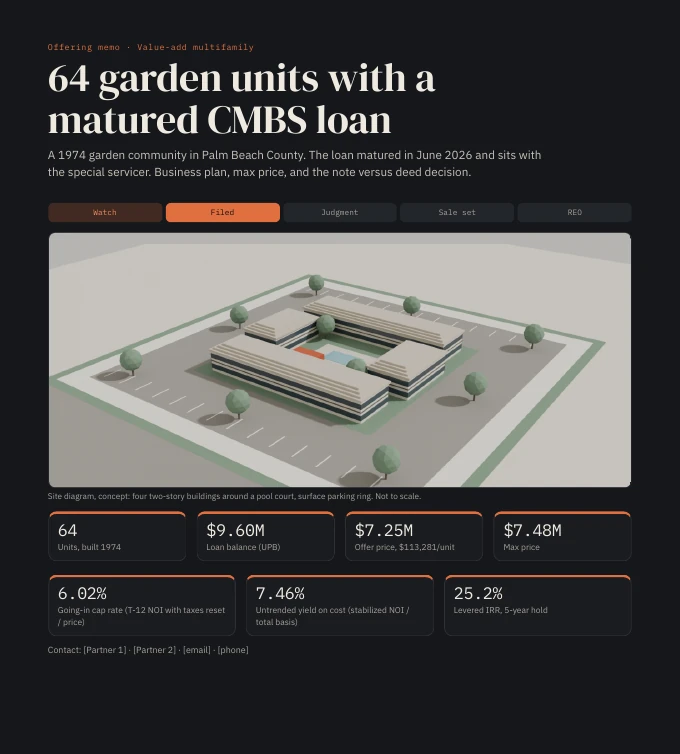 Deal B · Acquisition
64 garden units with a matured CMBS loan
Max price $7,484,958 at a 7.25% UYOC. Buying the deed beats buying the note by $195,536.
Sample deal, fictional site. Estimates, not an offer.
Track record
What it has caught on live projects
Real projects, real dollars, from Garrett's own work. Each one looked right on the page, was caught in review, fixed everywhere it had spread, and turned into a permanent check that runs every time. Project names withheld.
"I feel like I'm 10 people."
Garrett, on running 5 to 6 projects at once with the system.
About
Garrett Kramer
Garrett leads 5 to 6 projects day to day as lead developer and plays a role across a portfolio of 30+ sites in South Florida, more than $3B in total development cost, without being hands-on in every one. He began in acquisitions as a founding member of an institutional real estate fund, underwriting 506 Class A multifamily units from sourcing through investment committee, closing and asset management. He then spent two and a half years developing 1,300+ Class A multifamily units, about $450M of development cost, across entitlements, construction, lease-up, stabilization and a sale, taking on the full development manager role within six months. He has also worked on office and mixed-use loan workouts.
He built the system because he has done the work it supports and knows where projects lose time and money. M.S. in Finance and B.B.A. in Accounting and Finance, University of Miami.
Contact
Send a site, a model or a question.
Tell me what you have and where it stands. I will tell you which vertical and engagement fit, and what it takes to get you an answer.
Clients and pilot users: run jobs, track agents and download results.